Vehicle 1: Vision A 93
When: Fall 1993
Where: Frankfurt International Motor Show
Vehicle 2: “Studie A”
When: March 1994
Where: Geneva Motor Show
What: A compact-class car incorporating innovative solutions on interior space and safety
Powertrain:
- Four-stroke three-cylinder gasoline engine, 1.2 liter displacement, 55 kW (75 hp), front-wheel drive, continuously variable transmission (CVT)
- Three-cylinder diesel engine, 1.2 liter displacement, 44 kW (60 hp), front-wheel drive, continuously variable transmission (CVT)
- Electric induction motor, 40 kW (54 hp)
Following closely in the tracks of the “urban and short-distance vehicle” (NAFA) concept of 1982 and the F 100 research vehicle of 1991, Vision A 93 introduced numerous ideas which were new to the automotive industry.
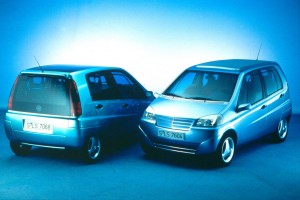
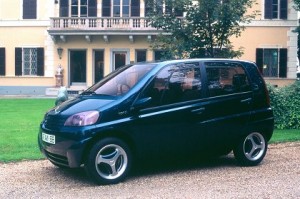
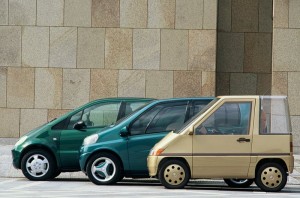
Unusual challenges – Vision A 93 was to be small but at the same time spacious – called for unusual solutions. And that’s exactly what the Mercedes engineers came up with when they developed the “sandwich floor”. In Vision A 93 the engine and transmission formed a compact unit which sat mainly underneath rather than in front of the occupants – a solution which also helped to maximize interior space. The distance between the driver or front passenger and the rear-seat passengers was 82.5 centimeters. That was the kind of figure previously only associated with upper mid-range models, as the press information was quick to point out. The concept vehicle was just 3.35 meters long, and the first version of the production vehicle, the short-wheelbase A-Class, measured just 3.60 meters. Another benefit of the sandwich floor was the high seating position, which gave a better view and added to the sense of safety
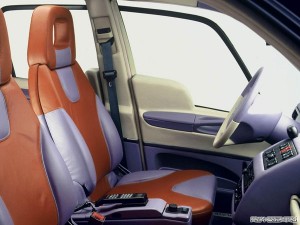
The sandwich principle also allowed Vision A 93 to meet the same high standards as other Mercedes-Benz models on safety. In a frontal collision, the engine was shunted out of the way under the floor, thus preventing intrusion into the passenger compartment. This is an ideal solution for a vehicle with a short front section and therefore a short crumple zone. In other respects too, crash safety conformed to Mercedes-Benz standards. Further safety features included full-size driver’s and front passenger’s airbags, belt tensioners, large side impact protectors in the doors and an integrated child seat in the rear.
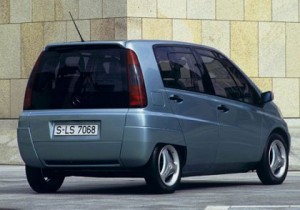
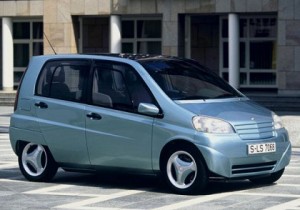
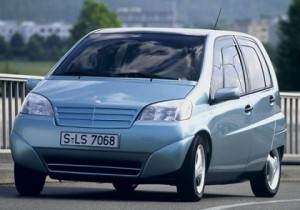
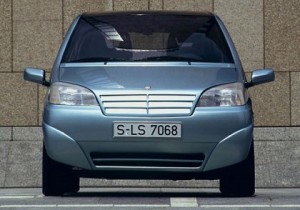
On styling, the Vision A 93 engineers were faced with a creative challenge. The unusual proportions – short and tall – made coming up with an aesthetically pleasing overall design rather tricky. At the same time, although this was intended to be a small car it was not supposed to look small. But the designers proved equal to the challenge. What they did was to develop an “integral” shape with an appearance similar to that of a people carrier. The windshield was positioned well to the front, with a high roof and a level floor. The short front end was skillfully integrated in the overall design.
A further important feature of Vision A 93 was environment-friendly design, for example as regards the powertrain. Three versions were presented. Two 1.2 liter, three-cylinder internal combustion engines – a direct-injection diesel engine (44 kW/60 hp) and a gasoline engine (55 kW/75 hp) – offered excellent fuel efficiency and lowest possible emissions.
They were combined with a continuously variable transmission (CVT), which brought further benefits for economy. At the same time a further version was presented which featured a 40 kW/54 hp electric induction motor, whose battery gave a range of 150 kilometers in urban operation.
Also, as the design specifications had envisaged, Vision A was well-suited for other types of alternative propulsion as well. Since 1997, Mercedes-Benz has been using the A-Class in fuel cell trials. This had been planned from the outset, and is mentioned in the original Vision A 93 press kit.
As Vision A and the A-Class demonstrate, even for an unusual design like this the timeframe from concept to production can be quite short. The new compact model proved something else as well: that unusual concept will always find a place on the market provided they are well thought-out and genuinely focused on future needs.
Technical highlights
- Sandwich floor -> introduced 1998 in the A-Class (W 168)
- ARTHUR (Automatic Radiocom Communication System for Traffic Emergency Situations on Highways and Urban Roads) -> first introduced by Mercedes-Benz 1998 in the Mercedes-Benz S-Class (W 220) under the name TELEAID
- Navigation system -> introduced 1995 in the Mercedes-Benz S-Class (W 140)
- Three-cylinder engines -> introduced 1998 in the smart city coupe (later known as the smart fortwo)
- Aluminum body


Mar 27 2014
1993 Vision A and 1994 “Studie A”
Vehicle 1: Vision A 93
When: Fall 1993
Where: Frankfurt International Motor Show
Vehicle 2: “Studie A”
When: March 1994
Where: Geneva Motor Show
What: A compact-class car incorporating innovative solutions on interior space and safety
Powertrain:
Following closely in the tracks of the “urban and short-distance vehicle” (NAFA) concept of 1982 and the F 100 research vehicle of 1991, Vision A 93 introduced numerous ideas which were new to the automotive industry.
Unusual challenges – Vision A 93 was to be small but at the same time spacious – called for unusual solutions. And that’s exactly what the Mercedes engineers came up with when they developed the “sandwich floor”. In Vision A 93 the engine and transmission formed a compact unit which sat mainly underneath rather than in front of the occupants – a solution which also helped to maximize interior space. The distance between the driver or front passenger and the rear-seat passengers was 82.5 centimeters. That was the kind of figure previously only associated with upper mid-range models, as the press information was quick to point out. The concept vehicle was just 3.35 meters long, and the first version of the production vehicle, the short-wheelbase A-Class, measured just 3.60 meters. Another benefit of the sandwich floor was the high seating position, which gave a better view and added to the sense of safety
The sandwich principle also allowed Vision A 93 to meet the same high standards as other Mercedes-Benz models on safety. In a frontal collision, the engine was shunted out of the way under the floor, thus preventing intrusion into the passenger compartment. This is an ideal solution for a vehicle with a short front section and therefore a short crumple zone. In other respects too, crash safety conformed to Mercedes-Benz standards. Further safety features included full-size driver’s and front passenger’s airbags, belt tensioners, large side impact protectors in the doors and an integrated child seat in the rear.
On styling, the Vision A 93 engineers were faced with a creative challenge. The unusual proportions – short and tall – made coming up with an aesthetically pleasing overall design rather tricky. At the same time, although this was intended to be a small car it was not supposed to look small. But the designers proved equal to the challenge. What they did was to develop an “integral” shape with an appearance similar to that of a people carrier. The windshield was positioned well to the front, with a high roof and a level floor. The short front end was skillfully integrated in the overall design.
A further important feature of Vision A 93 was environment-friendly design, for example as regards the powertrain. Three versions were presented. Two 1.2 liter, three-cylinder internal combustion engines – a direct-injection diesel engine (44 kW/60 hp) and a gasoline engine (55 kW/75 hp) – offered excellent fuel efficiency and lowest possible emissions.
They were combined with a continuously variable transmission (CVT), which brought further benefits for economy. At the same time a further version was presented which featured a 40 kW/54 hp electric induction motor, whose battery gave a range of 150 kilometers in urban operation.
Also, as the design specifications had envisaged, Vision A was well-suited for other types of alternative propulsion as well. Since 1997, Mercedes-Benz has been using the A-Class in fuel cell trials. This had been planned from the outset, and is mentioned in the original Vision A 93 press kit.
As Vision A and the A-Class demonstrate, even for an unusual design like this the timeframe from concept to production can be quite short. The new compact model proved something else as well: that unusual concept will always find a place on the market provided they are well thought-out and genuinely focused on future needs.
Technical highlights
By Catalin Varvara • Visions MB 0 • Tags: 1993 mercedes Studie, 1994 mercedes studie, Studie a, vision A, vision a class