Short-distance vehicle (NAFA) – Short on size, big on ideas. Study of an urban and short-distance vehicle with Mercedes breeding.
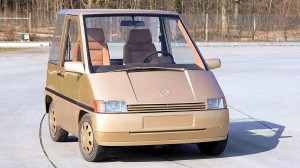
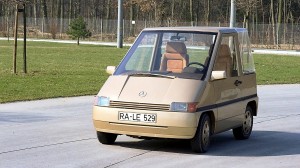
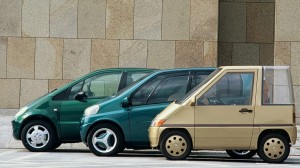
In the summer of 1982 Mercedes-Benz come up with a new concept officially titled “Short-distance vehicle” (NAhverkehrsFAhrzeug in German), but known by its German abbreviation NAFA. With an overall length of 2.50 meters and an overall height and width of 1.50 meters, the innovative two-seater contradicted everything the company was known to stand for to date.
An automotive study with front-wheel drive (it was for the first time when Mercedes-Benz made a car with front wheel traction) and two seats that packaged together ideas for an innovative city car with Mercedes-Benz flair which the manufacturer also intended to offer in an extended three or four-seater version.
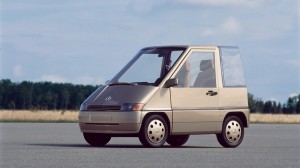
The most important feature of NAFA was the four-wheel steering, which gave her supreme maneuverability even in the tightest spaces and a turning circle of 5.7 meters.
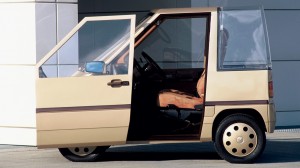
There were also sliding doors offering effortless access even when parked up close to other cars or garage walls, while the ingenious dimensional concept ensured occupants enjoyed sufficient levels of comfort and freedom of movement despite the body’s short length.
Under the hood, a three-cylinder engine from Japan with a capacity of 30 Kw (40 HP) was rumbling. The three cylinder engine fit so beautiful in this “feasibility study”.
Automatic transmission, power steering, air conditioning, belt tensioners plus other features which made it perfectly compatible with the demands of city driving: a low waistline, high seating position and expansive windows affording an optimum all-round view, were all intended to make short-distance motoring safer and altogether more enjoyable.
The only reason the study did not make it to the factory production line was that it simply could not match up to the Mercedes-Benz strict safety criteria which place occupant protection at the top of the list of priorities.
In order to overcome this hurdle, ingenious new ideas were needed which only materialized after 14 years in the form of the sandwich concept in the A-Class in 1996 and in the safety cell in the smart city coupe, introduced in 1997, both of them being manufactured in large numbers.
1982 Mercedes-Benz NAFA – A German review about NAFA


Dec 4 2013
1982 Mercedes-Benz NAFA
Short-distance vehicle (NAFA) – Short on size, big on ideas. Study of an urban and short-distance vehicle with Mercedes breeding.
In the summer of 1982 Mercedes-Benz come up with a new concept officially titled “Short-distance vehicle” (NAhverkehrsFAhrzeug in German), but known by its German abbreviation NAFA. With an overall length of 2.50 meters and an overall height and width of 1.50 meters, the innovative two-seater contradicted everything the company was known to stand for to date.
An automotive study with front-wheel drive (it was for the first time when Mercedes-Benz made a car with front wheel traction) and two seats that packaged together ideas for an innovative city car with Mercedes-Benz flair which the manufacturer also intended to offer in an extended three or four-seater version.
The most important feature of NAFA was the four-wheel steering, which gave her supreme maneuverability even in the tightest spaces and a turning circle of 5.7 meters.
There were also sliding doors offering effortless access even when parked up close to other cars or garage walls, while the ingenious dimensional concept ensured occupants enjoyed sufficient levels of comfort and freedom of movement despite the body’s short length.
Under the hood, a three-cylinder engine from Japan with a capacity of 30 Kw (40 HP) was rumbling. The three cylinder engine fit so beautiful in this “feasibility study”.
Automatic transmission, power steering, air conditioning, belt tensioners plus other features which made it perfectly compatible with the demands of city driving: a low waistline, high seating position and expansive windows affording an optimum all-round view, were all intended to make short-distance motoring safer and altogether more enjoyable.
The only reason the study did not make it to the factory production line was that it simply could not match up to the Mercedes-Benz strict safety criteria which place occupant protection at the top of the list of priorities.
In order to overcome this hurdle, ingenious new ideas were needed which only materialized after 14 years in the form of the sandwich concept in the A-Class in 1996 and in the safety cell in the smart city coupe, introduced in 1997, both of them being manufactured in large numbers.
1982 Mercedes-Benz NAFA – A German review about NAFA
By Catalin Varvara • Concept Cars 0 • Tags: 1982 mercedes, 1982 nafa, Mercedes Benz NAFA, NAFA