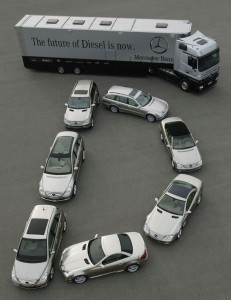
In 1987 Rudolph Diesel invented the diesel engine and in 1935 Mercedes-Benz rolled out the first diesel passenger car, W138 260D, a midsize sedan powered by a 45 HP, 2.5 liter, diesel engine. At the Geneva Motor Show in 2005, Mercedes-Benz is celebrating its 70th anniversary of producing diesel engines by presenting two diesel concepts and another five new diesel cars.
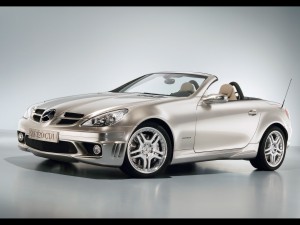
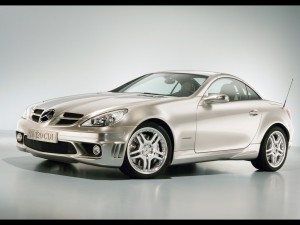
With this, Mercedes-Benz showed the direction that developments will be heading in the future. This claim to spearheading developments is highlighted by the uniform paint job for the show cars, which also points the way to the future. The paint covers the body panels like a metallic skin, emphasizes the design lines more strongly than any previous paint job and makes them more lively by means of targeted light reflections. The paint’s remarkable sparkle and brilliance is the result of a newly developed process that was used for the first time by Mercedes-Benz. While the pigments in a conventional metallic paint measure between 100 and 300 nanometres in size, those in the new ALU-BEAM paint are even much smaller (30 to 50 nanometres). In addition, the pigments are specially worked so that they are more uniformly spread within the paint’s surface. As a result, light is reflected with even greater brilliance and the paint’s sheen is substantially enhanced.
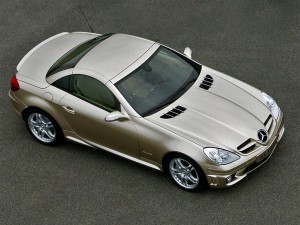
The direction in which the engineers at Mercedes-Benz are taking compression ignition engines is being shown in Geneva by the two diesel-powered roadsters that boast record performance figures.
– A new V8 engine generates 315 HP in the Vision SL 400 CDI and provides the eight-cylinder’s crankshaft with an outstanding torque of 730 Nm.
– The SLK 320 CDI tri-Turbo that can generate an impressive 286 HP and 630 Nm of torque from three liters of displacement (70.3 kW and 211 Nm per liter of displacement).
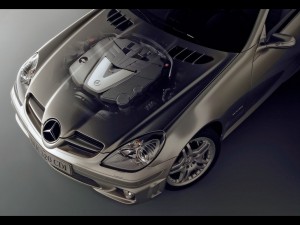
The SLK 320 CDI tri-Turbo is based on the new V6 common-rail diesel engine, which achieves new levels of performance thanks to a two-stage supercharging system. It consists of three Turbochargers, of which two are located on the outside next to the cylinder banks while the larger third Turbocharger is situated between the V of the cylinders. At low engine speeds and loads, air flows through all three Turbochargers (i.e., large and small), with the small Turbochargers doing most of the work. When engine speed increases and the flow is continuous, the large Turbocharger takes over supplying the greatest share of the charge pressure and the smaller Turbochargers are turned off by means of a bypass system. At high engine speeds and loads, only the large Turbocharger is running. Performance is further heightened as a result of an enlarged intercooler and larger pipe diameters for the charge air and the exhaust.
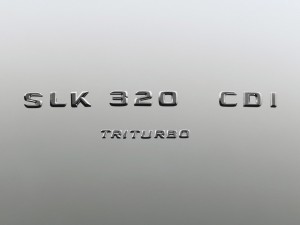
Sporting a modified tachometer with a red zone extending from 4,500 to 5,000 rpm and the self-confident appearance of the SLK 55 AMG, the vehicle is a proud member of the Mercedes-Benz diesel family. The new engine gives the roadster an impressive boost and allows it to perform prodigious feats: It takes the car but 5.3 seconds to accelerate from 0 to 100 km/h, and it can travel a distance of 1,000 meters in just 24.4 seconds from a standing start. The top speed is meanwhile electronically limited to 250 km/h. With this kind of performance, the SLK 320 CDI tri-Turbo has a unique standing even among thoroughbred sports cars. And fuel economy is just as impressive, since, despite the incredible driving performance, the diesel roadster consumes only 7.5 liters of fuel per 100 kilometers (NEDC overall consumption).
Leopold Mukulic, the man in charge of Benz’s engine development, said that the Tri-Turbo engine was a breakthrough in diesel performance. He added, “We’re confident about its ability in a production environment, but the cost of assembly is extremely high.” While the cost prohibits the Tri-Turbo engine from being mass produced, at least for now, it doesn’t rule out a limited or specialty run.
Body Type: 2-door hardtop roadster
Engine: 286 hp, 464 lb-ft of torque, 3.0L, 24-valve, triple -turbo charged DOHC V6
Transmission (estimated): 7-spdauto
Acceleration (0-100 km/h): 5.3 seconds
Top Speed: 250 km/h (155 mph)
Fuel Consumption: 7.5 L/100 km
Brakes (front/rear): disc/disc, ABS, EBD, BA
Seating Capacity: 2


Aug 22 2014
2005 Mercedes-Benz Vision SLK 320 CDI tri-turbo
In 1987 Rudolph Diesel invented the diesel engine and in 1935 Mercedes-Benz rolled out the first diesel passenger car, W138 260D, a midsize sedan powered by a 45 HP, 2.5 liter, diesel engine. At the Geneva Motor Show in 2005, Mercedes-Benz is celebrating its 70th anniversary of producing diesel engines by presenting two diesel concepts and another five new diesel cars.
With this, Mercedes-Benz showed the direction that developments will be heading in the future. This claim to spearheading developments is highlighted by the uniform paint job for the show cars, which also points the way to the future. The paint covers the body panels like a metallic skin, emphasizes the design lines more strongly than any previous paint job and makes them more lively by means of targeted light reflections. The paint’s remarkable sparkle and brilliance is the result of a newly developed process that was used for the first time by Mercedes-Benz. While the pigments in a conventional metallic paint measure between 100 and 300 nanometres in size, those in the new ALU-BEAM paint are even much smaller (30 to 50 nanometres). In addition, the pigments are specially worked so that they are more uniformly spread within the paint’s surface. As a result, light is reflected with even greater brilliance and the paint’s sheen is substantially enhanced.
The direction in which the engineers at Mercedes-Benz are taking compression ignition engines is being shown in Geneva by the two diesel-powered roadsters that boast record performance figures.
– A new V8 engine generates 315 HP in the Vision SL 400 CDI and provides the eight-cylinder’s crankshaft with an outstanding torque of 730 Nm.
– The SLK 320 CDI tri-Turbo that can generate an impressive 286 HP and 630 Nm of torque from three liters of displacement (70.3 kW and 211 Nm per liter of displacement).
The SLK 320 CDI tri-Turbo is based on the new V6 common-rail diesel engine, which achieves new levels of performance thanks to a two-stage supercharging system. It consists of three Turbochargers, of which two are located on the outside next to the cylinder banks while the larger third Turbocharger is situated between the V of the cylinders. At low engine speeds and loads, air flows through all three Turbochargers (i.e., large and small), with the small Turbochargers doing most of the work. When engine speed increases and the flow is continuous, the large Turbocharger takes over supplying the greatest share of the charge pressure and the smaller Turbochargers are turned off by means of a bypass system. At high engine speeds and loads, only the large Turbocharger is running. Performance is further heightened as a result of an enlarged intercooler and larger pipe diameters for the charge air and the exhaust.
Sporting a modified tachometer with a red zone extending from 4,500 to 5,000 rpm and the self-confident appearance of the SLK 55 AMG, the vehicle is a proud member of the Mercedes-Benz diesel family. The new engine gives the roadster an impressive boost and allows it to perform prodigious feats: It takes the car but 5.3 seconds to accelerate from 0 to 100 km/h, and it can travel a distance of 1,000 meters in just 24.4 seconds from a standing start. The top speed is meanwhile electronically limited to 250 km/h. With this kind of performance, the SLK 320 CDI tri-Turbo has a unique standing even among thoroughbred sports cars. And fuel economy is just as impressive, since, despite the incredible driving performance, the diesel roadster consumes only 7.5 liters of fuel per 100 kilometers (NEDC overall consumption).
Leopold Mukulic, the man in charge of Benz’s engine development, said that the Tri-Turbo engine was a breakthrough in diesel performance. He added, “We’re confident about its ability in a production environment, but the cost of assembly is extremely high.” While the cost prohibits the Tri-Turbo engine from being mass produced, at least for now, it doesn’t rule out a limited or specialty run.
Body Type: 2-door hardtop roadster
Engine: 286 hp, 464 lb-ft of torque, 3.0L, 24-valve, triple -turbo charged DOHC V6
Transmission (estimated): 7-spdauto
Acceleration (0-100 km/h): 5.3 seconds
Top Speed: 250 km/h (155 mph)
Fuel Consumption: 7.5 L/100 km
Brakes (front/rear): disc/disc, ABS, EBD, BA
Seating Capacity: 2
By Catalin Varvara • Visions MB 0 • Tags: Meredes-Benz SLK 320, SLK 320 CDI tri-turbo, tri-turbo